Pakistan - From North to South

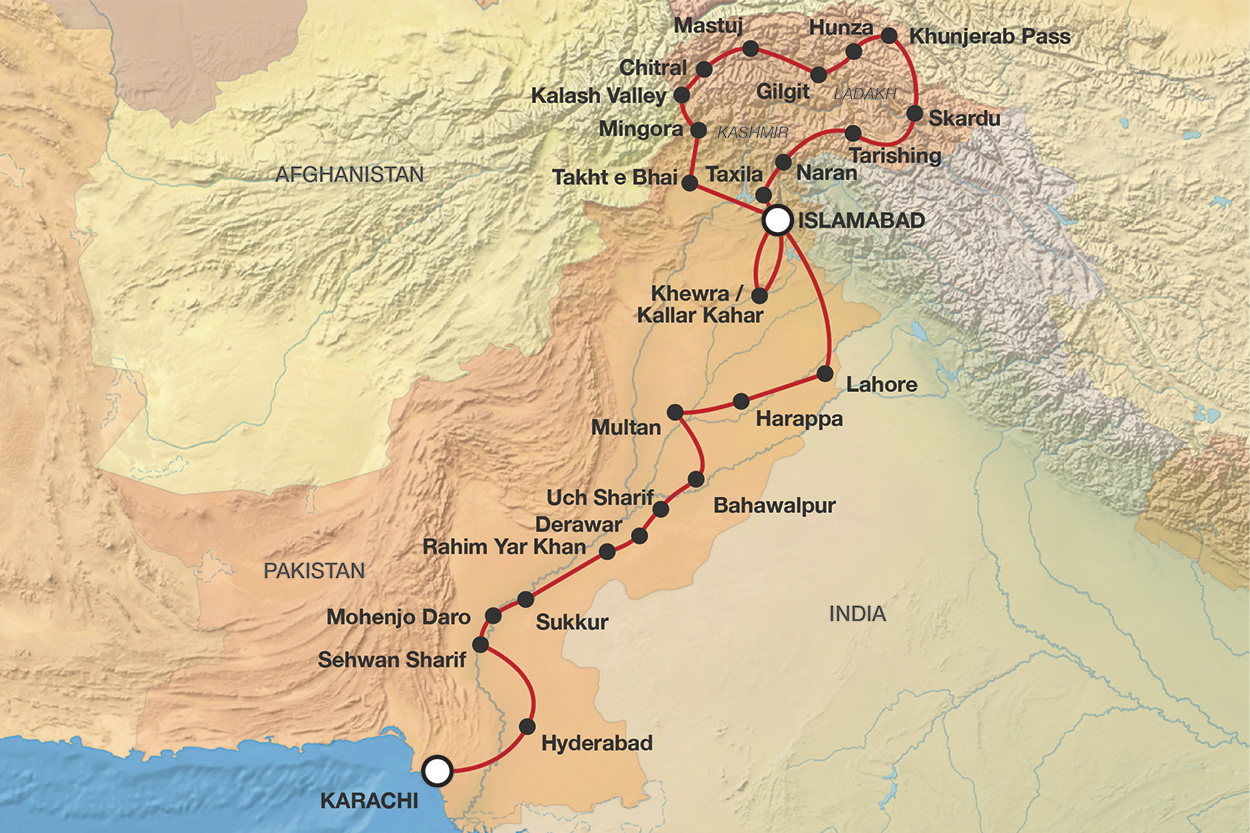
The ultimate tour of Pakistan, from the isolated mountain communities and magnificent scenery of the north, to the vibrant culture, Mogul heritage and sufi shrines of the south.

Starting in Islamabad we travel north to Chitral, and enter the valleys of the Kalash people, often described as ‘pagans’ and with a culture that is very different to the rest of the country. After joining them at one of their colourful annual festivals we continue north, our journey framed by enormous jagged peaks and glaciers, taking us over high passes on the way to the ancient kingdom of Hunza.

We explore old forts, see remnants of the region’s Buddhist history, and see traditional life in this remote corner of Pakistan, far from the bustling cities of the south. Heading over the Karakorum Highway, we reach Baltistan in the northeast, India and China and more like Tibet than anything else.

We then cross the desolate Deosai Plateau, and continue on the Karakorum Highway until we return to Islamabad.

From here, the trip changes as we immerse ourselves into the joyful chaos that is modern day Pakistan. In Lahore we discover the glories of the Mogul Empire, with its intricate architecture, gardens and shrines. We visit Multan – the ‘city of saints’ – to see colourful religious traditions, mingling with local pilgrims and worshippers in an exuberant display of devotion of faith that is quintessentially Pakistani.

We discover some of the world’s oldest civilisations at Harappa and Mohenjo Daro, explore feudal forts and ancient necropolises, and end our journey in the ever lively city of Karachi.

From the glaciers of the Hindu Kush to the Arabian Sea at Karachi, Pakistan is towering mountains, ancient civilizations and vibrant cities. Above all, though, Pakistan is its people – whose warmth, resilience and generosity are at the heart of every journey.
Highlights

  • The atmospheric city of Lahore
  • Join the Kalash people at their annual festival
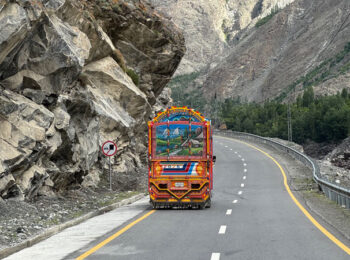
  • Incredible mountain scenery on the Karakorum Highway
  • Mingle with pilgrims at the holy shrines of Multan
  • The ancient civilisations of Harappa and Mohenjo Daro
Day 1 - Islamabad

Arrive in Islamabad and transfer to your hotel. Depending on time of arrival, there may be time to explore the twin cities of Islamabad and Rawalpindi. Islamabad is the capital of Pakistan and Rawalpindi is an old British-era settlement. We wander among Rawalpindi’s many varied bazaars and visit the imposing Shah Faisal Mosque, situated at the foot of the Margalla Hills. This mosque is one of the largest in the world with room for 15,000 worshippers inside and 85,000 in the courtyard. We will also visit the Daman e Koh and the Pakistan monument and the bustling Raja Bazar Rawalpindi. Overnight Hill View Hotel or similar.

Islamabad

Pakistan’s capital is a modern creation, built in the 1960s on a grid pattern and lacking the chaos that exemplifies most of the subcontinent. At the crossroads of the Punjab and the North West Frontier Province, Islamabad is the most modern city in Pakistan, and the seat of government, but lacks the history and character of Karachi, Lahore or Quetta. Islamabad was chosen as the site for a new capital after it was felt that Karachi wasn’t central enough to be truly representative, and was also heavily affected by the monsoon period. Sitting next to the older city of Rawalpindi, Islamabad is the most cosmopolitan city in Pakistan and is in utter contrast to what you will see throughout the rest of the trip.

Day 2 - Takht-e Bhai – Mingora

We start our journey north, heading to the city of Mingora. We stop on the way at the Gandharan monastery of Takht-e Bhai, which dates back to the 1st century AD. Overnight Rock City Hotel or similar. (BLD)


Days 3-5 - Kalash Valleys

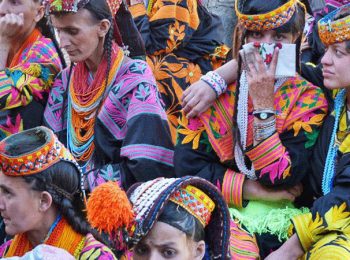
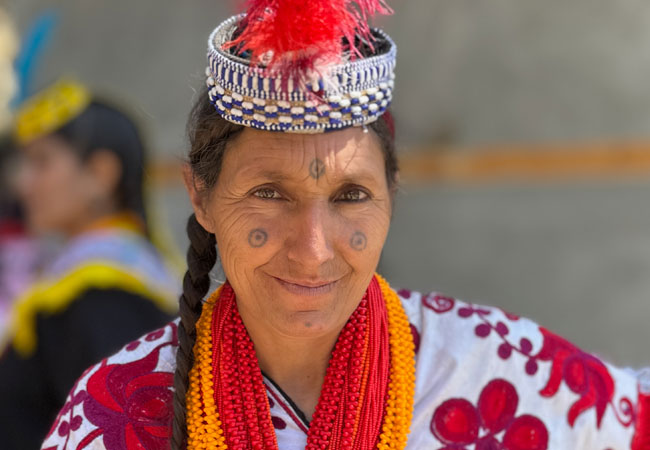
Drive north to the Kalash Valleys, arriving in the afternoon of Day 3. The Kalash are a ‘pagan’ tribe believing in the old gods, known to the outside world for their vibrant traditions and very unlike the other ethnic groups of Pakistan. Legend says that they are the descendants of four Greek soldiers of Alexander’s army. The women wear black robes and a skull-cap decorated with sea shells and coins. We visit the valleys of Birir, Rambur and Bamburet to see unique cattle houses, ancient deities and picturesque villages. Our tour has been timed to coincide with the local festival of Phoo to see some of the Kalash’s incredible cultural traditions. Overnight Guesthouse. (BLD)

The Kalash

The Kalash are one of the most fascinating – and striking – ethnic groups in all of Central Asia. Confined to a few valleys in the Chitral region, the Kalash once held sway here but with the arrival of Islam retreated into some of the more isolated areas to maintain their unique beliefs. The Kalash are polytheistic, venerating nature and the spirits, and make sacrifices to give thanks for harvests. Women wear traditional dress, which consists of colourful beads and skullcaps adorned with cowrie shells and bright embroidery, offset against black robes – the effect is quite striking and is a key part of their cultural identity. As with many ethnic groups however, the men are less traditional and usually wear the Pakistani shalwar kameez. According to legend the Kalash are descended from four of Alexander the Great’s generals, to whom Alexander gave the Chitral Valley as a reward, and whatever the truth they look very different from most other Pakistanis, with fairer skin and distinct facial features.

Festivals are important to the Kalash – the three main ones being Joshi in late May, Uchau in autumn and the Caumus festival in midwinter. These are times of great celebration when the Kalash come together to thank their gods for protecting their livestock and ensuring good harvests. This is a great time to be in the region, and these are some of Pakistan’s most exuberant and enchanting festivals.

Day 6 - Chitral – Mastuj

In the morning we leave for Chitral, and briefly explore the town including the Shahi Mosque and Chitral Fort. We then continue to Mastuj village, one of the prettiest towns in the Chitral area. The fort in Mastuj was built over 300 years ago and was once the seat of the local Kushwaqt tribe who inhabited the land from northern Chitral to the territories of Ghizr and Yasin in Gilgit. The land here is dotted with walnut, apricot and apple trees and is part of a farm owned by a local family called the Ulmulk’s. We may see the family going about their daily chores such as milking the cows and tending to the lambs. Overnight local guesthouse. (BLD)

Chitral

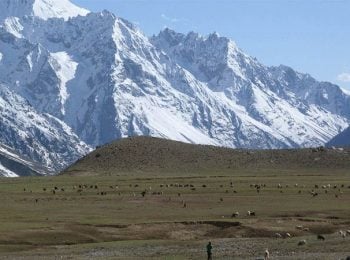
The Chitral Valley is one of Pakistan’s most isolated regions, situated in the north west of the country along the border with Afghanistan and with limited connections to the outside world. Once an independent kingdom, it fell under British control during the ‘Great Game’ period of the late 19thcentury, when the British were pushing ever further into the unexplored regions of Central Asia to secure the frontiers of the Indian Empire against Russian encroachment. Dominated by the mountains of the Hindu Kush, the scenery here is utterly breathtaking with the 7700 metre peak of Tirich Mir visible throughout the valley. This is an area of ancient traditions, incredible landscapes and fascinating ethnic groups.

Day 7 - Shandur Pass – Phander – Gupis

Today we drive over the Shandur Pass (3700m) and through the Phander Valley, dotted with pretty lakes and inhabited by the Ismaili people, to reach Gupis. Overnight Metropolitan Hotel or similar. (BLD)

Shandur Pass

After Laspur village the zigzag jeep track climbs up the Shandur pass (3,700m), home to the highest polo ground in the world. Each year a grand festival of polo takes place here, and teams from all of North Pakistan meet together to decide the champion of the year. The festival is attended by many enthusiasts from every village, who camp here for days to see their team progress towards glory.

Day 8 - Gilgit - Hunza Valley

Drive to Gilgit, once an important city on the Silk Road and a significant place with regards to spreading the Buddhist religion throughout Asia. From here continue to Karimabad, in the Hunza Valley. On the way we have excellent views of Rakaposhi and Ultar peak, stopping for tea at a viewpoint to see Rakaposhi in its all glory from its summit to its glaciers. Other stops en route include the rock-carved Buddha at Kargah and the colourful bazaars at Gilgit. When we reach Karimabad, we will be surrounded by peaks towering above 7000 metres. Overnight Hunza Darbar Hotel or similar. (BLD)

Gilgit

As the administrative capital of the region, the town is of strategic importance to the northern areas of Pakistan. Even before it became important during the imperial rivalries of the Great Game of the late 19th century, it was the centre of numerous regional disputes amongst the petty kingdoms that inhabited the area. With the arrival of the highway, the town has undergone rapid social and economic change, and most people who travel through northern Pakistan make a stop here.

Day 9 - Hunza Valley

Begin our day at Baltit fort, a 774-year-old fort placed on a hilltop overlooking Karimabad. From here we descend to the Ganesh Old Settlement, the oldest inhabited village in the Hunza Valley, renowned for its heritage conservation. Continue to Altit Fort which is even older than Baltit Fort, and is considered the birthplace of the Hunza Kingdom. In the evening, head to the charming hamlet of Duikar to watch the sunset. Overnight Hunza Darbar Hotel or similar. (BLD)

Hunza

Hunza was an independent state for most of its existence, with strong links to China and Kashmir and playing an important role in the trade between Central Asia and the subcontinent, but its flirtation with Imperial Russia in the late 19th century led to it being annexed by the British. Nevertheless, it retained a semi-autonomous status until 1974, finally being dissolved and fully incorporated into Pakistan, although it’s fair to say that old traditions die hard and still today it feels like a world unto itself. Most of the inhabitants here are Shia Muslims, and languages spoken include Burushaski, Wakhi and Shina, reflecting the ethnic diversity of the region. Like Chitral, Hunza is surrounded by towering peaks and the scenery is amazing. The main centre here is Karimabad, once known as Baltit and home to a dramatic fort, more akin to the architecture of Tibet than anywhere else.

For many centuries, Hunza provided the quickest access to Swat and Gandhara for a person travelling on foot. The route was impassable for pack animals; only human porters could get through, and then only with permission from the locals. Hunza was easily defended as the paths were often less than half a metre in width.

The high mountain paths often crossed bare cliff faces on logs wedged into cracks in the cliff, with stones balanced on top, terrifying to many of those that made the journey here.

Day 10 - Khunjerab Pass

Travel to the Khunjerab Pass, the highest point on the Karakorum Highway, at an elevation of 4733m. The pass boasts lush green meadows and frozen lakes, and is a habitat for numerous species including the snow leopard. On the way we stop at the sacred rocks of Ganish, with carvings over 2000 years old. Continue to Attab lake, pass over the Hussaini suspension bridge and stop at the Passu glacier viewpoint before finally arriving at Khunjerab Pass. Return to Karimabad for the night. Overnight Hunza Darbar Hotel or similar. (BLD)

Karakorum Highway

The Karakoram Highway, also known as the Friendship Highway in China, was built by the governments of Pakistan and China, it was started in 1959 and was completed in 1979 (open to the public since 1986) about 810 Pakistanis and about 200 Chinese workers lost their lives, mostly in landslides and falls, while building the highway. The route of the KKH traces one of the many paths of the ancient Silk Road.

Day 11 - Skardu

Follow the Hunza River downstream, reaching the confluence of three mighty mountain ranges – the Karakorum, Himalaya and Hindu Kush. We then follow the course of the Indus, zigzagging through the narrow gorges of the Karakorum, to reach the capital of Baltistan, Skardu. Overnight Qayam Skardu Motel or similar. (BLD)


Day 12 - Skardu

Spend the day exploring Skardu and its surrounds, including the Manthal Buddha Rock, an important relic of Buddhism dating back to the 8thcentury. We also visit the high-altitude desert of Katpana with its huge sand dunes. Also known as the Cold Desert, Katpana sits at 2226m above sea level and is one of the highest deserts in the world. Overnight Qayam Skardu Motel or similar. (BLD)

Baltistan

In a region of stunning landscapes, Baltistan stands out, dominated by foreboding mountains that cannot fail to remind visitors that they are now in one of the wildest and remote corners of Asia. Pushed up against the borders of India and China, Baltistan is often referred to as ‘little Tibet’ and most of the people here are of Tibetan descent, although now Muslim. Islam arrived here in the 14th century but the architecture still betrays the Buddhist past of the region, with buildings often resembling the monasteries and fortresses of Tibet, and the culture here contrasts sharply with regions to the west. Baltistan is best known for its mountains and trekking – one can trek to the mighty K2 or Concordia – but has much to offer the non-trekker. Crossing the Deosai Plateau is a journey you are unlikely to forget, and if you’re lucky you might spot some wildlife – it is home to Himalayan brown bear, Tibetan wolf and ibex among other species. Elsewhere gushing rivers and pristine valleys abound, while picturesque villages dot the slopes. Polo is said to have been invented here, and many villages contain polo grounds for playing the sport.

Day 13 - Deosai Plateau – Astore

A long but rewarding day, crossing the Deosai Plateau, a treeless wilderness at 4,000m. The Deosai Plateau is now a national park and is home to more than forty Himalayan brown bears, one of Pakistan’s most endangered species, as well as wolf, ibex and other species. En route we visit the Sadpara lake which is striking turquoise in colour. Overnight Dejani Resort or similar. (BLD)


Day 14 - Naran

Continue our journey south to the town of Naran situated in the Kaghan valley (2409m). Overnight Jovial Gold Hotel or similar. (BLD)


Day 15 - Taxila - Islamabad

Explore the archaeological site of Taxila, an early centre of Buddhism, and continue to Islamabad for the evening. Overnight Hill View Hotel or similar. (BLD)


Day 16 - Islamabad

Today we visit Rohtas Fort, a UNESCO world heritage site built by the Afghan king Sher Shah in the 16th century. Overnight Hill View Hotel or similar. (BLD)


Day 17 - Khewra - Ketas - Lahore

Visit the Khewra salt mines, the largest in the world and reputedly dating back to the time of Alexander the Great. We also visit the salt lake and marshes at Kallar Kahar, a haven for birdlife, and the Hindu temples at Ketas. Continue to Lahore for the night. Overnight Four Points Hotel or similar. (BLD)

Lahore

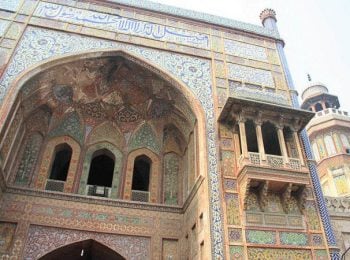
Considered by many to be the cultural capital of Pakistan, Lahore is one of the great centres of Mughal architecture, with a bewildering array of monuments and sites to explore.  Its origins are lost in the mists of time but the city rose to prominence in the 11th century when it was developed by Mahmud of Ghazni, who made it the capital of the Ghaznavid Empire. In subsequent years it was ruled over by a number of different dynasties until its sack by the Mongols in 1241, when it was raised to the ground. But it was the Mughal period, from the 16th to 18th centuries, that Lahore is most closely associated with today, and many of its most impressive monuments date from this time including the Badshahi Mosque, Shalimar Gardens and Lahore Fort. Combined with its chaotic old bazaars and colonial remnants from the era of British rule, Lahore is one of Pakistan’s most fascinating cities.

Days 18-19 - Lahore

Explore the key sights of the city including the Lahore Fort, Badshahi Mosque, and Shalimar Gardens, among others. We will also witness the famous flag-lowering ceremony at the Wagah border. Overnight Four Points Hotel or similar. (BLD)


Day 20 - Harappa - Multan

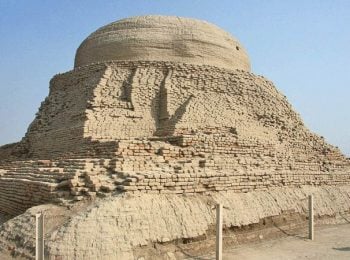
Drive to Multan, visiting Harappa on the way. Harappa dates back to the 3rd millennium BC and after Mohenjo Daro is the most important site of the Indus Valley civilisation. Overnight Best Western Hotel or similar. (BLD)


Day 21 - Multan - Bahawalpur

Spend the day exploring Multan, the ‘city of saints’, noted for its remarkable shrines and mosques. This was the first town of the Punjab to be captured by Muhammad bin Qasim in 711 AD. Ruled at the time by a Brahmin dynasty, it eventually became a major Islamic centre. Since then it has attracted more mystics and holy men than perhaps anywhere else on the subcontinent and is today dominated by their shrines and tombs, which we explore. From here, continue to Bahawalpur for the night. Overnight Hotel One or similar. (BLD)


Day 22 - Derawar – Uch Sharif – Sukkur

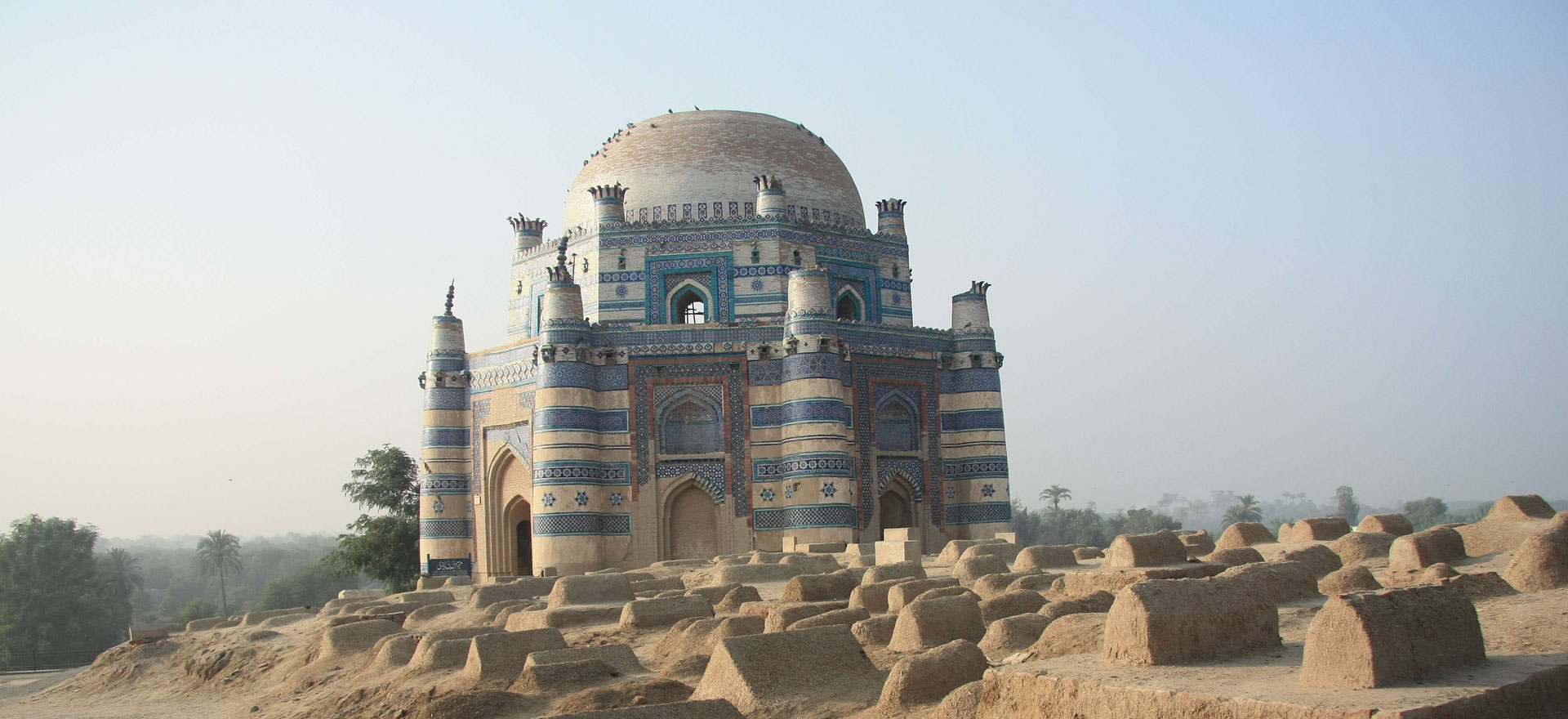
Drive to Sukkur. En route visit Derawar Fort, built in the 9th century by the Rajputs and its massive walls rise from the Cholistan desert to a height of 30 metres, as well as Uch Sharif with its stunning ruined tombs, the oldest of which dates to the 12th century. Later, we take a boat trip around the island of Sadu Bela to look for Indus River dolphins. Arrive in Sukkur in the evening. Overnight Royal Taj Serene or similar. (BLD)


Day 23 - Larkana

After breakfast, drive to Larkana, stopping first at the Faiz Mahal palace built in the 18th century, with its collection of historic artefacts. Continue to the fort of Kot Dijji, said to be the largest in Asia, before arriving in Larkana in the evening. Overnight Royal Taj Serene or similar. (BLD)


Day 24 - Mohenjo Daro

Leave Larkana heading for Sehwan. On the way, stop at Mohenjo Daro, one of the most important sites of the ancient Indus valley civilization, and one of Pakistan’s greatest archaeological treasures. We also visit the Shrine of Lal Shahbaz Qalandar before arriving in Sehwan. Overnight Hotel Sehwan Divine or similar. (BLD)

Mohenjo Daro

Discovered in the 1920s, Mohenjo Daro was one of the most important cities of the Indus Valley Civilisation, and dates back to approximately 2500 BC – around the same time as ancient Egypt and Mesopotamia. Spread out over three hundred hectares, it is believed that at its peak around 40,000 people lived here, making it one of the largest and most advanced cities in the world at the time. Laid out in a grid system and built out of baked bricks, the city featured a complex water management system, complete with a sophisticated drainage and covered sewer system, and baths in nearly every house.

Day 25 - Hyperabad

This morning, we continue to Hyderabad. First, we stop at Ranikot Fort with its vast walls – in a rather remote location, no-one quite knows what it was built to defend, and its origins are unclear. We then move onto the Tomb of Bhit Shah, the final resting place of the Sufi poet Shah Latif. Overnight Hotel PC Legacy or similar. (BLD)


Day 26 - Karachi

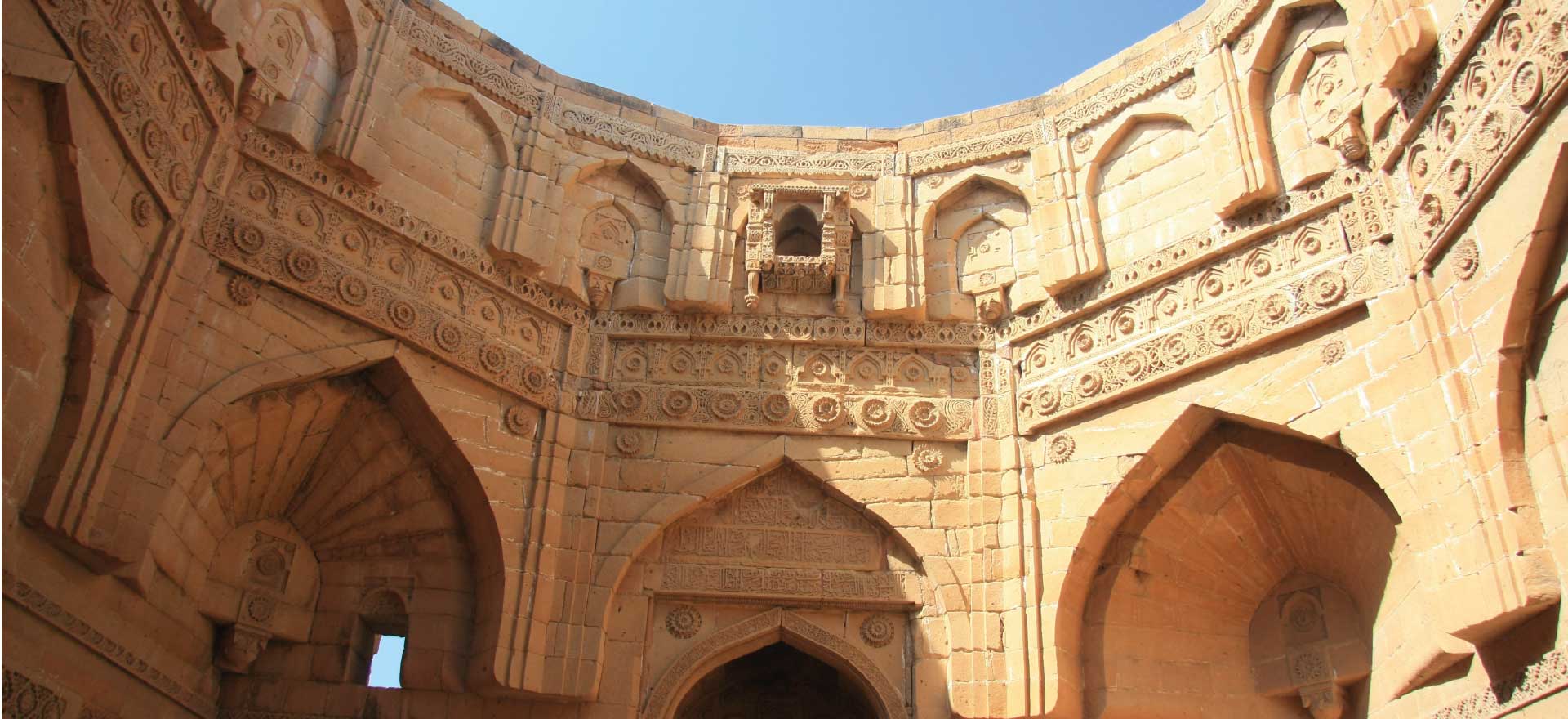
Start the day visiting one of the most beautiful mosques in Pakistan, the Shah Jahan Mosque Thatta built in the 17th century. We then move onto the vast necropolis of Makli, said to contain over a million graves, including the 16th century tomb of Mirza Jani Beg and the 17th century mausoleum of Diwan Shirfa Khan. We also visit the ancient city of Banbhore, and the unique Chaukhandi tombs. Finally, arrive in Karachi, Pakistan’s largest city. Overnight Embassy Inn Hotel or similar. (BLD)


Day 27 - Karachi

Spend today exploring Karachi, Pakistan’s largest city with a population of over 20 million, and the heart of the nation’s economy. We visit the National Museum of Pakistan for an insight into the country’s troubled history, the Quaid-i-Azam Mausoleum, and other sights like the old British era buildings. Overnight Embassy Inn Hotel or similar. (BLD)


Day 28 - Karachi

Transfer to the airport for your flight home. (B)


Pre-tour Peshawar Extension

Day 1 - Islamabad

Arrive in Islamabad and transfer to your hotel. Overnight Hill View Hotel or similar.


Day 2 - Peshawar

Take the train from Rawalpindi to Peshawar, travelling through northern Punjab and the province of Khyber Pakhtunkhwa (formerly known as the North West Frontier Province). On arrival, visit the Qissa Khani bazaar, known as the bazaar of storytellers and once an important point on trade routes connecting India and Central Asia. Overnight Tourmaline Hotel or similar. (B)

Peshawar

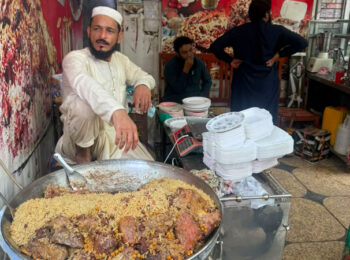
Peshawar (Pronounced Pe-SHAH-Wur), the capital of Khyber-Pukhtunkhwa (KP), is a frontier town, the meeting place of the subcontinent and Central Asia. It is perhaps the oldest living city in this part of Asia – a place where ancient traditions jostle with those of today, and where the bazaar in the old city has changed little in the last hundred years except to become the neighbour of a modern university, some modern hotels, some international banks and one of the best museums in Pakistan. The city is one of the oldest cities of Pakistan with recorded history dating back to 539 BC, and is famous for its food.

Day 3 - Peshawar

Spend the day exploring Peshawar. We visit the excellent museum with its Buddhist artefacts dating to the Gandharan period, as well as other sites such as the Jamrud Fort, the Kharkhano bazaar (famous for smuggled goods) and the 17th century Mohabbat Mosque. Overnight Tourmaline Hotel or similar. (B)


Day 4 - Peshawar - Islamabad

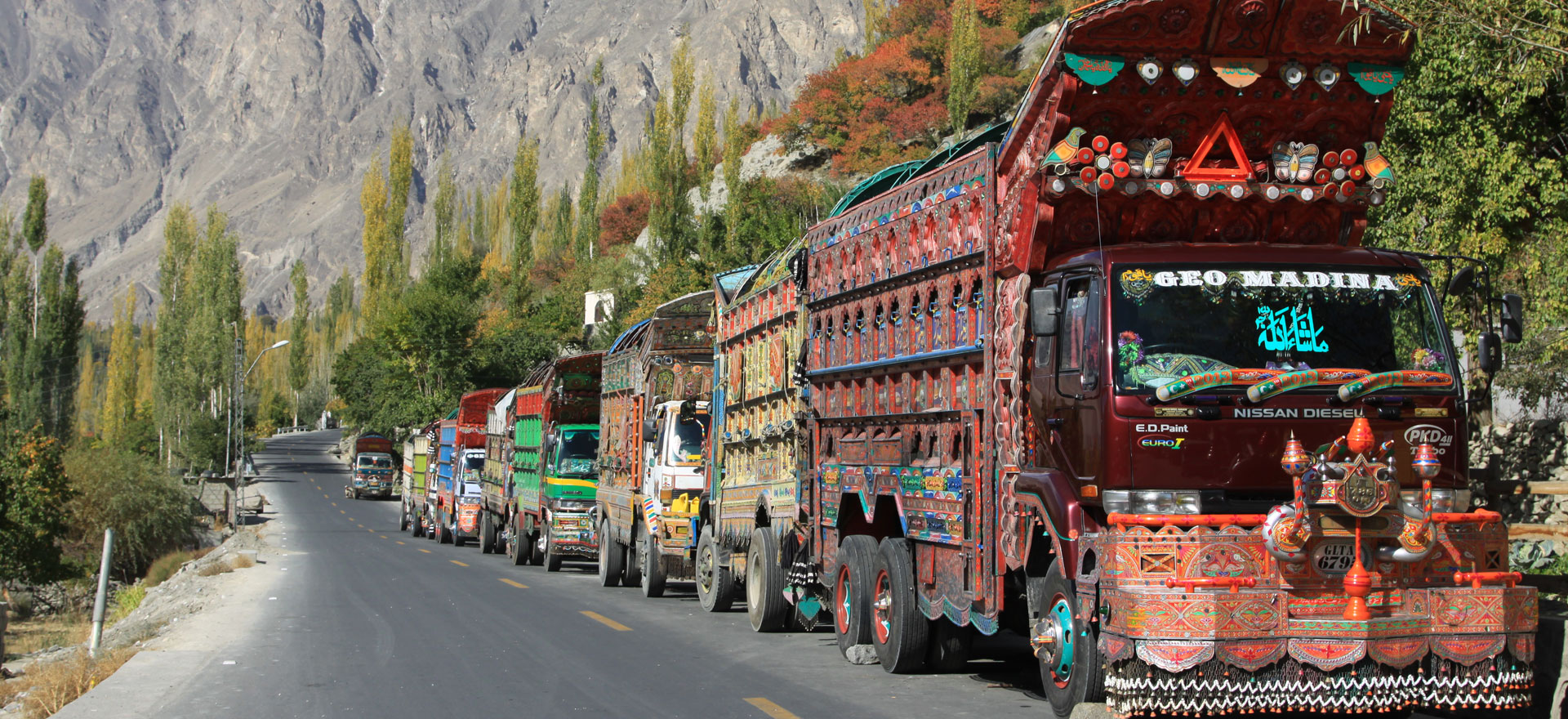
This morning we visit the impressive mausoleum of Rahman Baba, and then head to a workshop that specialises in the elaborate art that decorates so many of Pakistan’s trucks. Truck art is highly prized here, with some owners spending several thousand dollars – more than the cost of a house – to decorate their vehicles. Afterwards, return to Islamabad. Overnight Hill View Hotel or similar. (B)


Day 5 - Islamabad

As per Day 1 of the group tour.


Indus Valley Explorer
Kalash women in traditional dress - Pakistan tours
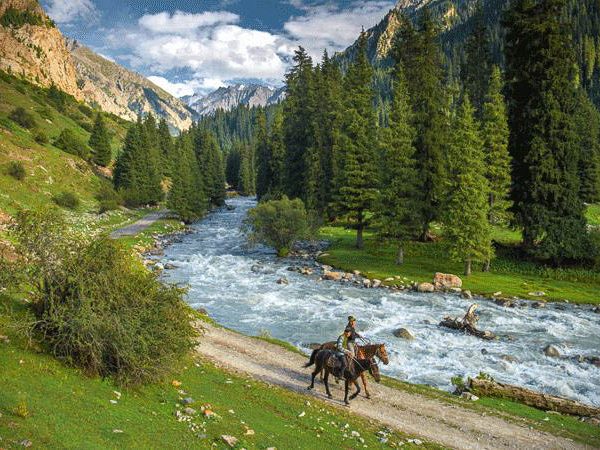
Mountains scenery in northern Pakistan

What's included?

  • Airport transfers

    We include arrival and departure transfers on the first and last days of the tour regardless of whether you book flights yourself, or we book them for you. If you’re booking them yourself, then please let us know the details so that we can arrange the transfers. Please note though that if you arrive earlier than Day 1 of the tour, and leave after the final day, we may need to make an additional charge for an airport transfer.

  • Accommodation

    Accommodation as listed in the dossier. The nature of the destinations that we operate may sometimes mean that we need to change hotels, but we’ll always endeavour to keep the same standards. Please be aware that as we operate in many countries where tourism is in its infancy, hotel standards may not be the same as you’re used to elsewhere.

    Please note that while we prefer to use centrally located hotels where possible, this is not always practical and in some locations they may not be the best option in terms of standards or reliability.

  • Guides

    You will be accompanied by English-speaking guides.

  • Meals

    As listed within the itinerary / dossier (B-Breakfast, L-Lunch, D-Dinner). These will vary from trip to trip – in some areas it makes sense to include all meals while in others there is a good choice of restaurants and we feel people might like to ‘do their own thing’ now and again. Please note that when meals are included, sometimes these will be in hotels, as often these are the most appropriate option, and will sometimes be set menus. Local restaurants are often lacking in variety, as well as the capacity to cater for groups. Drinks are not included and are at your own expense.

  • Entrance fees

    Entrance fees are listed for those sites that we mention within the itinerary. If there are any other sites that you’d like to see, these would be at your own expense.

What's not included?

  • Visas

    We don’t arrange visas for our travellers, but if an invitation letter is necessary then we will arrange this for you. If you need any advice with visas then just give us a call, or alternatively a visa agency such as Travcour (www.travcour.com) can assist.

  • Airport taxes

    If there are any departure taxes to pay that are not included within the cost of your ticket, you’ll need to pay these yourself.

  • International flights

    Many of our travellers arrive from different destinations and so we don’t include international flights in the cost of our tours. If, however, you would like us to book flights for you, then just give us a call and we’ll be happy to discuss your options.

  • Travel insurance

    If you need any assistance with this, then let us know – although we can’t arrange it ourselves, we can point you in the direction of a reputable provider that can assist.

Visas

All travellers require a visa for Pakistan and this can be applied for online here: https://visa.nadra.gov.pk/tourist-visa/

You should ensure that your passport has at least six months’ validity after the end date of your trip. We also strongly recommend that your passport has a minimum of two blank pages next to each other – on rare occasion it may lead to problems with visas and immigration authorities if it does not.

Visa applications can sometimes be complicated, and e-visa platforms do not always work as well as they might, particularly across different internet browsers and when uploading particular documents. We provide supporting documentation that you may need from us, such as hotel confirmations and invitation letters, but once you have actually made your application, our ability to get involved and resolve any minor issues (such as files not uploading) is extremely limited. We therefore strongly recommend that you consider using the services of a visa agency when making a visa application. Of course, they will charge for their services but can save you a lot of time and frustration, and are familiar with the processes and occasional quirks of visa applications. In the UK, we would recommend Travcour (https://travcour-vls.com) as a reliable visa agency.

When applying for your visa, please bear in mind that any flight schedule changes could mean that you enter and/or leave the country a day earlier or later than planned. You should bear this in mind when mentioning your entry date into the country and your departure date from the country, on your visa application.

Health and vaccinations

We are not medically qualified and so we recommend that you speak to your doctor or nearest health professional for advice concerning recommended vaccinations. For more advice on vaccinations you can also visit https://travelhealthpro.org.uk/countries

Insurance

It is a condition of joining our tours that you have suitable travel insurance in place, and we cannot accept travellers without insurance. All policies differ in terms of what they will cover, but as a minimum you need medical and health cover which will cover you for the whole time that you are away. Most policies will also include cancellation cover, which will cover you if an unforeseen circumstance obliges you to cancel your trip. We recommend that you obtain your insurance as soon as you book your trip.

Please note that government travel warnings often affect the validity of your travel insurance, and you should check this with your insurance company.

Money

The local currency in Pakistan is the rupee. British pound sterling, US dollars or Euros are all fine to bring for exchange purposes. It’s not difficult to change money in Pakistan, either at banks or the hotels and your guide can assist with this. There are a good number of ATMs in Pakistan, although once you get further off the beaten track don’t count on there being any, or the rare ones that there are, to be properly working. For this trip it is best to change money in Islamabad, at the start.

Local conditions

When travelling to some of the destinations we offer you need to bear in mind that things won’t always work here as we’re used to them working at home. Travelling in underdeveloped and untouristed destinations requires both patience and a sense of humour. There may be problems with infrastructure, attitudes may be different, and maintenance may not be as high a standard as we would always like, but this is very much part and parcel of travelling in such a place. We aim to resolve any issues as quickly as possible, and thank you for your patience.

Travel advice

We keep a very close eye on the travel advice issued by the UK Foreign and Commonwealth Office so that we can keep you up to date with any warnings. At the time of writing the FCO advises against travel to some parts of Pakistan that this trip visits.

We work very closely with our local team and are fully confident that we can operate tours safely in Pakistan. Should you have any concerns over safety please do not hesitate to contact us and we can address your concerns.

This relates to advice from the British government – other nationalities need to check the stance of their own governments.

Indus Valley Explorer
Kalash women in traditional dress - Pakistan tours
Date(s)
Price (PP) Exc. Flights
Single Supplement
Trip Status
Date -
12 October 2027
Price (PP) -
£6,699
Single Supplement -
£850
Trip Status -
Available
Date -
12 October 2028
Price (PP) -
£6,999
Single Supplement -
£895
Trip Status -
Available